
History of Elgin National Watch Company
Elgin National Watch Company pavilion at the 1939 New York World’s Fair
Elgin made fine watches primarily for the middle- and upper classes. All Elgin watches had jeweled movements, using tiny sapphires as “working jewels” to reduce friction and increase precision. [1] Elgins watches ranged from models with 7 jewels in base metal cases, all the way up to luxury watches with 21 to 30 jewels in cases made of solid gold and platinum. Some of the high-end Elgins cost significantly more than a Rolex or Patek Philippe. [2] Elgin made fine timepieces at a time when a watch was a significant purchase meant to be used for many years — and made more watches with jeweled movements than any other company, ever.
Elgin made some incredible watches that belong in any great collection. Examples of the latter include Elgin’s 27- and 30-jewel automatics, widely considered to be the only American designed and made self-winding watches; the B.W. Raymond certified wrist chronometers of the early 1960s; the stunning C.H. Hulburd line of pocket watches of the 1920s and 1930s; the art deco Parisienne women’s watches of the same time period; and others. [3]
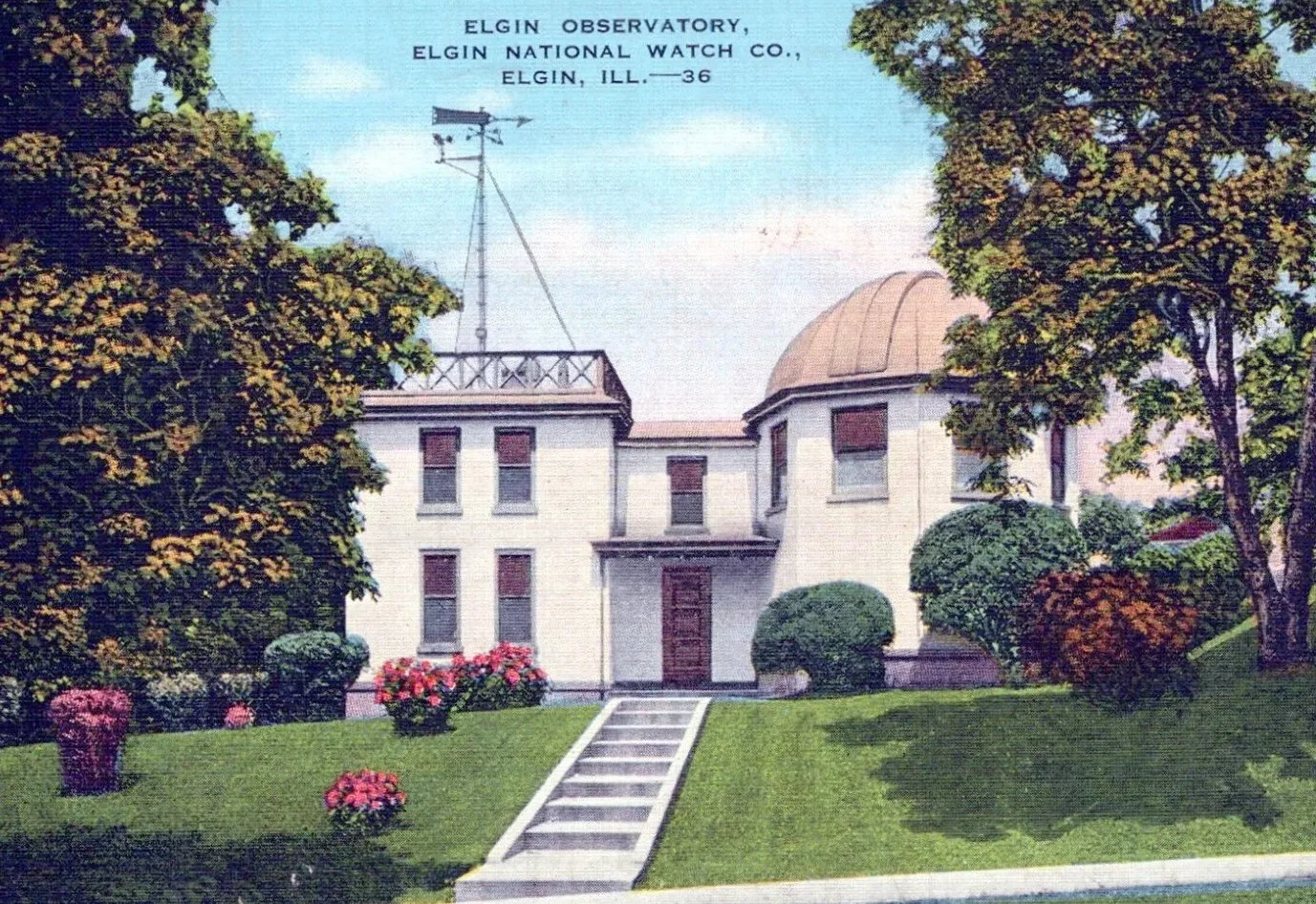
Elgin operated the world’s largest watch factory—the main plant in Elgin, Illinois—from 1866 until 1964, as well as several other U.S. plants after World War II. For half a century, Elgin operated its own astronomical observatory that allowed its watches to be precisely “Timed to the Stars.” It was the first watchmaker to make 50 million watches with jeweled movements, a feat celebrated in 1951 with an impressive 18k gold watch made in a limited run of 1,000 pieces.
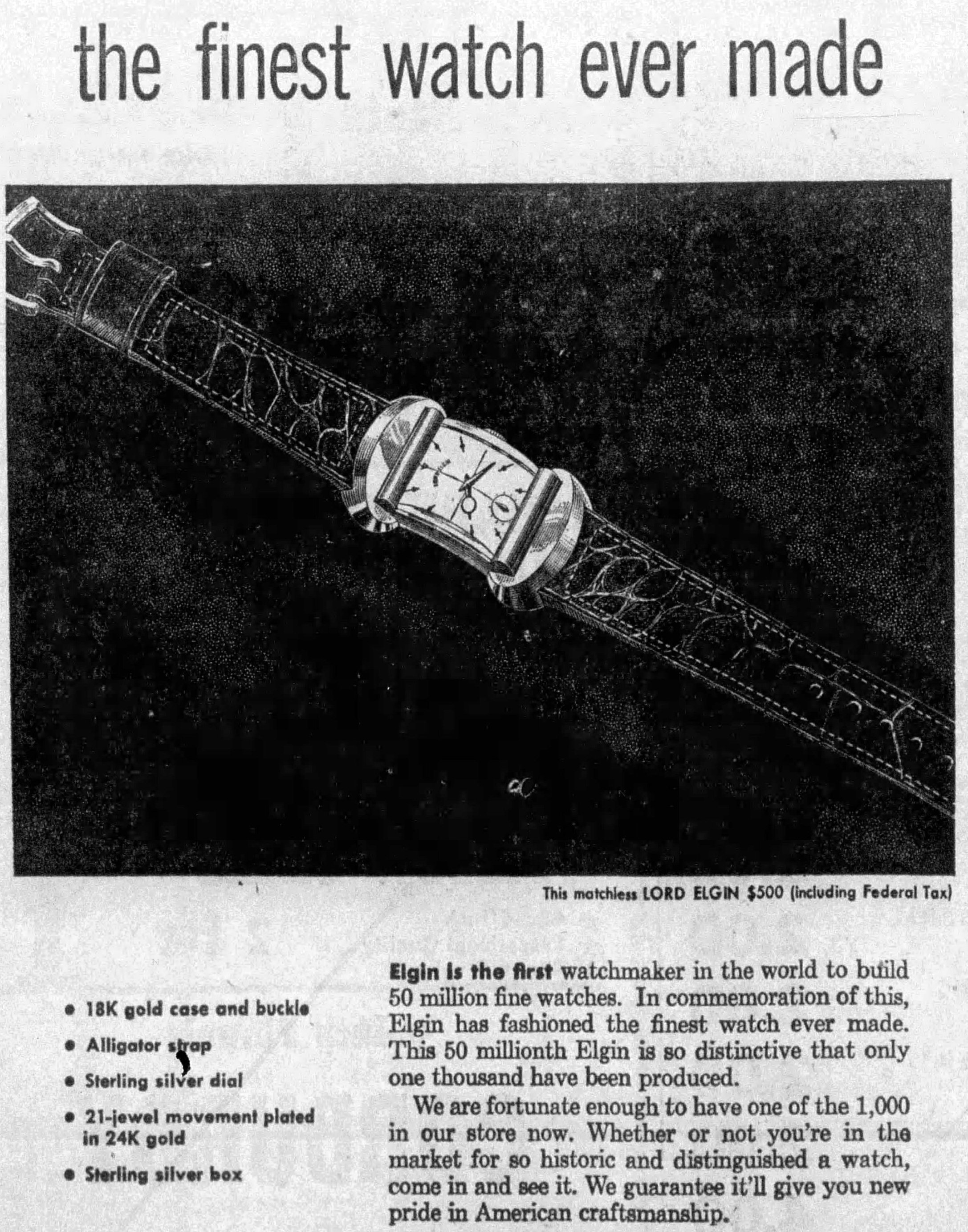
Only in 2019 did Longines, a luxury Swiss maker that competed against the high-end Elgins, make its 50 millionth watch. No other maker of quality jeweled timepieces has ever reached that figure. Elgin produced about half the jeweled watches ever made in the U.S., with the remainder made by famous competitors like Waltham, Hamilton, and others. In 1963, Elgin’s reputation for excellence led to it being chosen to build the central timing mechanism for NASA’s Apollo moon program. [4]
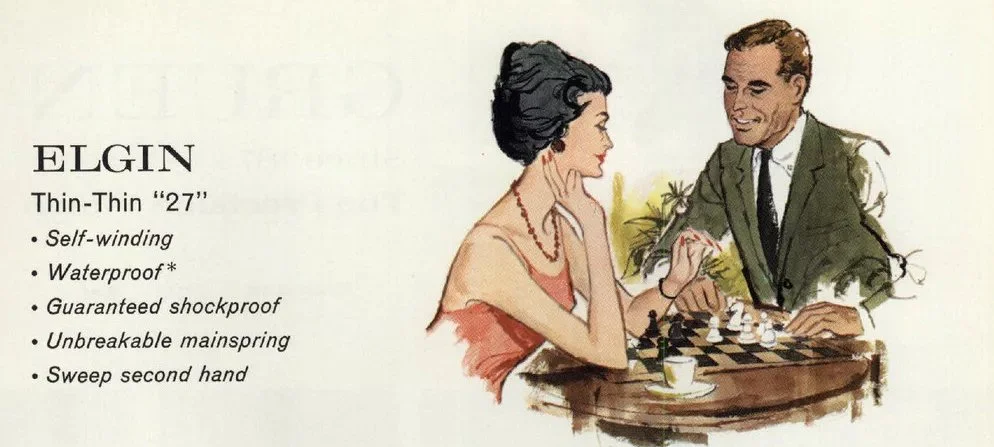
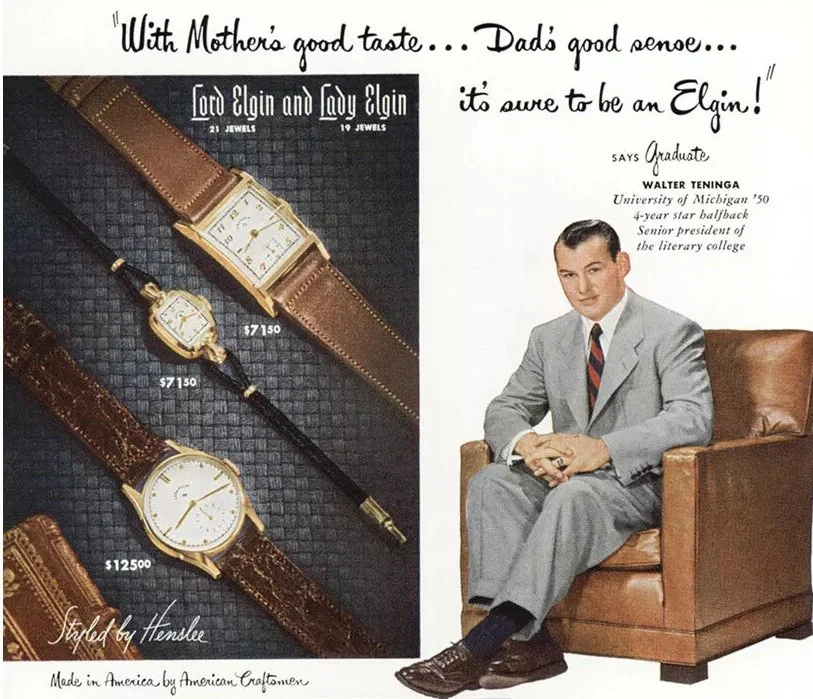
In its advertising we can see the kinds of customers Elgin sold to and the aspirations they held. Elgin made high quality watches for the managerial class and professionals, graduating students, glamorous women, and sporty men — the rising middle and upper classes of American society, and those who aspired to join them. Elgin was even retained by Tiffany to make luxury “8 day” timepieces, a travel and car accessory which ran for over a week with single winding.
In the mid-1950s, Elgin was one of the 500 biggest companies in America, producing around 1 million watches annually. And it was generally profitable, albeit with some very rocky periods: Elgin turned a profit in 20 of the 24 years between 1945-1968. Nonetheless, unfair trade policies forced it to diversify away from its core watch business into other areas. One such area was defense, such as building control devices for guided missiles. [5] Losses related to its military defense business in the mid-1960s are largely to blame for Elgin disappearing as an independent company in 1968. [6]
Today, the “Elgin” name is used to market lower price “fashion watches” made overseas that have nothing to do with the American-made Elgins sold for over a century. Nonetheless, the company’s impressive history lives on through its products: American Elgin created some of the most impressive watches ever made in the U.S., with fabulously decorated cases and dials, art deco and mid-century modern designs, technological innovations, and high quality movements which even today, when properly serviced, keep time exceptionally well.
——
Footnotes:
[1] “Jewels” refers to jeweled bearings. They are not decorations; they are specially shaped stones (usually synthetic garnets, rubies or sapphires), that act as bearings to reduce friction around pivot points, and make mechanical watches more precise. See https://elgintime.blogspot.com/2012/09/notes-on-elgin-watch-characteristics.html
[2] 1961 ads list Elgin watches priced up to $850. See December 4, 1961 Chicago Tribune, p. 37. Advertising from the same time period shows men’s Rolex watches starting at $165 and women’s at $185. See December 15, 1961 Indianapolis News, p. 12. Watches from Patek Philippe started at $350 during the same time period. See December 6, 1961, Sacramento Union at p. 1. These were of course among the most expensive watch prices; a typical watch at the time cost a small fraction of that, and some Elgins started under $20.
[3] A “chronometer is fundamentally a highly accurate mechanical watch movement that has undergone – and passed – strict precision tests over a period of time in a host of different circumstances.” https://www.longines.com/en-us/universe/blog/what-is-a-chronometer Neutral organizations do these tests. For example, Elgin’s 23 jewel B.W. Raymond Railroad Wrist Chronometer was approved in 1960 after testing by railroads whose employees needed extremely precise watches for safety reasons. See More Rails Okay Use of Wrist Watch, The Decatur Daily Review (IL), July 26, 1960, p. 8. Elgin’s 30 jewel automatics from the same time period are also considered “chronometer quality” by experts like Ranfft, the most complete watch movement database. https://ranfft.org/caliber/3525-Elgin-760. See also https://www.elgin.watch/enwco/events/watch-of-tomorrow/ ; see also Watchmaker Enlivens a Dull Cocktail Party, The Berkshire Eagle (Pittsfield, Mass.), Jan. 17, 1956, p. 3 (discussion with President James Shennan about electronic watch development at Elgin)
[4] On February 27, 1963, “Elgin National Watch Company received a subcontract from North American [Aviation] for the design and development of central timing equipment for the Apollo spacecraft. This equipment provided time-correlation of all spacecraft time-sensitive events.” See also Elgin advertisement in Spokane Chronicle, April 30, 1964, page 15.
[5] “Watch Firm Will Develop Parts for Guided Missiles,” Fort Worth Star Telegram, January 17, 1955
[6] Page 135 of the excellent Elgin Time: A History of the Elgin National Watch Company, 188 pages, available to order from the Elgin History Museum at https://elginhistory.org/product/elgin-time-a-history-of-the-elgin-national-watch-company-2020-reprint/